

Lakshmi Puja Vidhi: Step-by-Step Guide for Prosperity Prayers at Home

" Every Diwali, when we light the humble clay diya, we are not just lighting a wick. We are invoking Mother Lakshmi the divine energy of purity, moral composure, and true spiritual prosperity. Performing this puja at home with your loved ones brings endearment, focus, and a warm sense of cultural pride in Indian heritage."
1. What Is This About? A complete, step-by-step Lakshmi Puja Vidhi guide designed for Indian households to perform simple, authentic, and heart-felt prayers on Diwali.
2. Why It Matters: It cleanses the home environment, aligns your inner thoughts with moral truth and integrity, and invites true prosperity that stays through righteous action.
3. Who Is Impacted: Students, working youth, homemakers, and modern families who want to understand the spiritual meaning behind festival rituals and practice them easily.
4. Where Applicable: Directly inside your home puja room, quiet corner, or living room space prepared specifically for Diwali night prayers.
5. Action Roadmap: By thoroughly cleaning your home, setting up a simple sanctified altar, chanting mindful mantras, offering fragrant flowers, and performing aarti with deep focus.
"Where there is righteousness in the heart, there is beauty in the character. Where there is beauty in the character, there is harmony in the home." — Ancient Vedic Insight
📍 The Deeper Spiritual Significance: Understanding Maha Lakshmi Beyond Material Wealth

When we hear the name of Goddess Lakshmi during Diwali, most people immediately think of gold coins, cash boxes, and financial success. However, if we explore the Sanskrit etymology and philosophical roots of Indian heritage, we discover that the word Lakshmi comes from 'Lakshya', which means target or supreme purpose. True prosperity in Vedic thought is not merely paper money sitting in a bank account. It is 'Ashta Lakshmi' eight forms of divine wealth that include good health, courage, righteous knowledge, food security, strong character, family harmony, and moral peace. When you sit down for Lakshmi Puja, you are invoking the inner discipline required to build a purposeful and noble life.
In our ancient philosophical treatises, particularly in the timeless wisdom of Chanakya Neeti and the Bhagavad Gita, great emphasis is placed on living with moral truth and integrity. Wealth earned through dishonest shortcuts or greed never brings peace; it brings anxiety, family disputes, and sleepless nights. But when wealth is earned through honest hard work and ethical actions what our scriptures call 'Shubha Labha' or auspicious gain it stays in your house for generations. Performing Lakshmi Puja is an annual renewal of your pledge to earn your living righteously and spend it responsibly for the welfare of your family and society.
From the perspective of Vedic scientific rhythms and astronomy, Diwali marks the peak of the autumn season during the dark new moon night of Kartik Amavasya. During this cosmic transition, atmospheric temperatures cool down, and daylight hours shorten, which can naturally lower human energy levels. Lighting bright brass lamps, burning natural camphor, and chanting rhythmic Sanskrit verses act as physical and psychological energizers. They clear the stagnant energy around your home, sharpen your focus, and fill your mind with optimistic warmth, preparing you to meet the coming winter months with enduring inner peace and resilience.
📍 Essential Samagri & Altar Setup: Preparing Your Space with Purity

Before starting any prayer, environmental reverence and cleanliness are vital. The first step of Lakshmi Puja Vidhi begins hours before the evening prayers by thoroughly dusting, sweeping, and organizing your living quarters. Cleaning the physical house is actually a symbolic act of clearing clutter from our own minds. When your environment is clean, quiet, and well-lit, your thoughts naturally become organized and peaceful. Involve your family, youth, and children in decorating the entryway with fresh mango leaves, vibrant marigold flower garlands, and colorful rangoli patterns.
Setting up the Puja Chowki (elevated wooden platform) requires basic items that carry deep ancient symbolism. Cover the wooden chowki with a clean red or yellow silk cloth. Place a handful of clean raw rice grains in the center and carefully position the idols or pictures of Lord Ganesha and Goddess Lakshmi. Lord Ganesha represents wisdom and removing obstacles, while Goddess Lakshmi represents prosperity. Always place Lord Ganesha to the left of Goddess Lakshmi. Next to the idols, setup a traditional brass Kalash filled with clean water, a coin, a betel nut, and topped with fresh mango leaves and a coconut. This setup creates a sacred geometry that concentrates subtle positive vibrations right in your living room.
Gathering the essential samagri does not require expensive shopping. Keep these humble items ready on a clean brass plate: pure cow ghee or sesame oil for the diya, cotton wicks, natural camphor (kapoor), kumkum (vermilion), turmeric powder, unbroken rice grains (akshata), fresh fragrant flowers, sweet prasad like kheer or laddoo, and a small brass bell. Having all items arranged orderly before starting prevents rushing during the prayer, allowing you to maintain fulfilling dharmic duty with focus and heartfelt devotion.
📍 Step-by-Step Lakshmi Puja Vidhi: Line-by-Line Home Ritual Guide
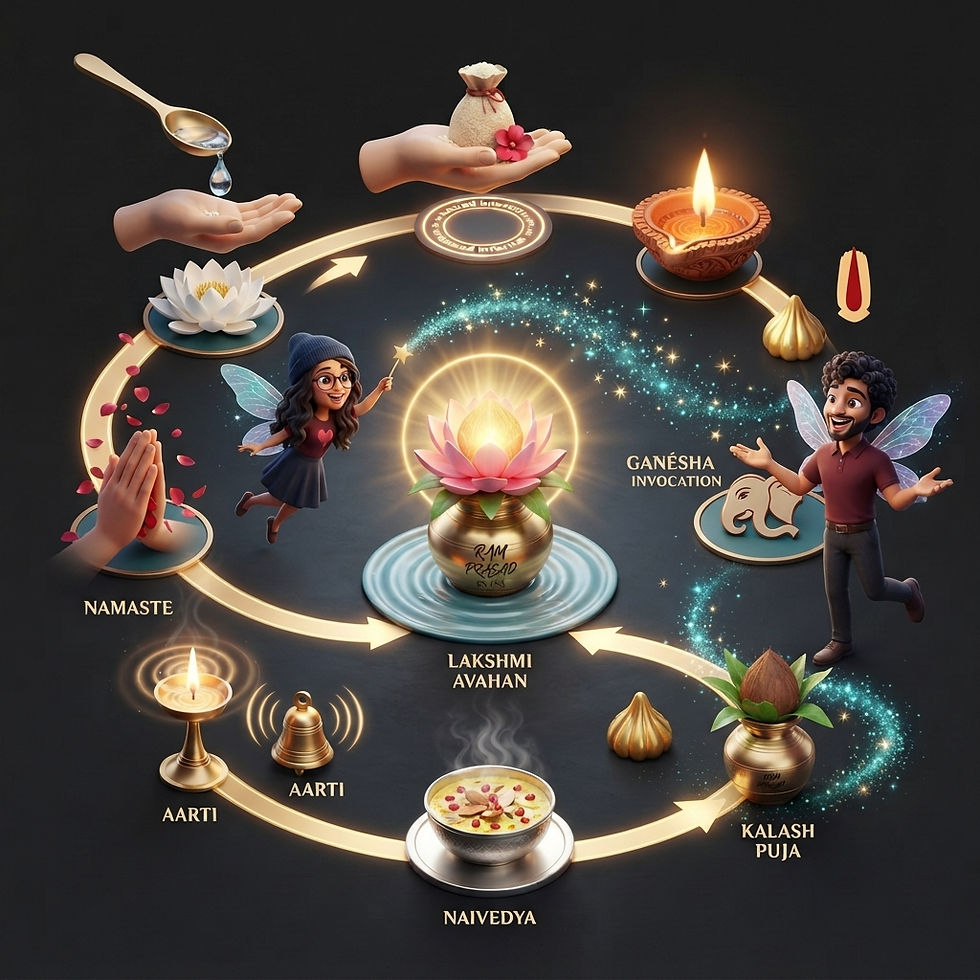
Follow these simple, line-by-line steps to perform the puja smoothly at home:
Pavitrikaran (Self-Purification): Sit comfortably facing East or North. Take a few drops of clean water in your right palm using a small spoon, sip it gently while chanting 'Om Keshavaya Namah, Om Naraynaya Namah, Om Madhavaya Namah', and wash your hands. This simple act resets your breath and calms your mind.
Sankalp (Sacred Resolve): Take a small pinch of rice grains, a flower petal, and a drop of water in your right hand. State your name, your location, and declare your simple intention to perform Lakshmi Puja with devotion for the peace, health, and moral prosperity of your family. Gently drop the items near the base of the altar.
Deep Prajvalan (Lighting the Lamp): Light the main brass ghee lamp placed on the right side of the altar. Offer a flower to the flame and bow your head, acknowledging the flame as the divine witness that removes dark ignorance from your heart.
4. Ganesha Puja (Invoking Wisdom): Apply a small drop of kumkum and akshata to the idol of Lord Ganesha. Offer a flower and chant a simple prayer: 'Om Gan Ganapataye Namah'. Pray for clear intelligence and the removal of all personal and mental hurdles.
Kalash & Varuna Puja: Touch the sacred Kalash with respect. Offer a few rice grains and flower petals, invoking the pure, life-giving waters of sacred rivers to bless your home with health and nourishment.
Lakshmi Avahan (Inviting Goddess Lakshmi): Offer fresh flowers, kumkum, and haldi to Mother Lakshmi. Chant her basic mantra: 'Om Shreem Hreem Maha Lakshmyai Namah'. Silently invite divine light and noble thoughts into your consciousness.
Naivedya Offering (Offering Prasad): Place the sweet prasad, fresh fruits, and clean drinking water in front of the divine idols. Sprinkle a drop of water around the food plate as a mark of respect and gratitude for the food on your table.
Mindful Aarti: Light camphor on a brass aarti plate. Ring the brass bell gently with your left hand while rotating the aarti plate clockwise in front of the deities with your right hand. Sing the traditional aarti with your family members in joyful unison.
Ksama Prarthana & Prasad Distribution: Close your eyes, bow down humbly, and ask for forgiveness for any unintentional mistakes during the ritual. Offer respectful salutations to the elders in your family, seek their blessings, and distribute the sanctified prasad to everyone with love.
📍 Mindful Mantras & Chanting: Harnessing the Subtle Power of Sacred Sound

The science of ancient Sanskrit shlokas lies in phonetic sound vibrations. When you chant Sanskrit mantras clearly and slowly, the sound frequencies resonate in your palate, stimulating nerve endings that send calming signals to your brain. This subtle power of mindful mantras transforms routine prayer into an active form of meditation. You do not need complex, lengthy verses if you find them difficult; chanting simple, pure sound syllables with full concentration creates high spiritual energy in your home.
One of the most potent chants for Diwali is the Lakshmi Beej Mantra: 'Om Shreem Hreem Shree Mahalaxmiyei Namaha'. The sound 'Shreem' is the seed syllable of peace, beauty, and abundance. When repeated 108 times using a wooden tulsi or lotus seed mala, it slows down your heart rate, reduces mental noise, and instills deep focus. Another beautiful hymn is the Sri Suktam from the Rigveda, which praises Mother Lakshmi not as a giver of selfish desires, but as the cosmic radiance that removes poverty, hunger, and negativity from the universe.
While chanting, encourage young students and family members to sit upright, close their eyes, and focus gently on the space between their eyebrows. Instead of mechanically repeating words while thinking about office work or phone messages, practice Nishkama Karma action performed with total presence and no anxious attachment to outcomes. This simple practice builds strong daily discipline, improves memory power for students, and leaves every family member feeling refreshed, calm, and mentally composed long after the puja ends.
📍 Post-Puja Harmony: Transforming Festival Prayers into Daily Dharmic Living

The true success of performing Lakshmi Puja Vidhi on Diwali is measured not by how long your prayer lasted, but by how your behavior changes from the next morning. Rituals are external maps designed to build internal character. Once the lights of Diwali dim down, the values of moral truth, honest work, and environmental care must continue in your daily routine. If we pray to Goddess Lakshmi for abundance but treat our workers unfairly, waste food, or speak rudely to elders, our prayers lose their authentic power.
In corporate workplaces, college campuses, and family households, living with moral truth and integrity is your real strength. Ancient Indian culture teaches us that real wealth grows when it is shared through charity (Daana), helpful service (Sewa), and civic responsibility. Take a portion of your Diwali sweets, clothes, or savings and share them with needy neighbors, security guards, or underprivileged children. When you bring a smile to someone else's face, you truly invite the living light of Maha Lakshmi into your home.
Finally, end your Diwali night by spending quality digital-free time with your family. Sit together, enjoy home-cooked food, listen to stories from grandparents, and honor the wisdom of your elders. Respecting elders and family unity builds a stable foundation where future generations grow up with confidence, emotional security, and unshakeable cultural pride in Indian heritage. Let the humble clay diya inspire you to remain grounded, perform your duty with focused excellence, and radiate kindness to everyone around you.
❓ FREQUENTLY ASKED QUESTIONS
Q1: What is the best time (muhurta) to perform Lakshmi Puja on Diwali at home?
Lakshmi Puja is traditionally performed during 'Pradosh Kaal' (the evening twilight period lasting around 2 hours after sunset) when Pradosh Kaal overlaps with Vrishabha Lagna (a stable, fixed zodiac sign symbolizing steady wealth and peace).
Q2: Can I perform Lakshmi Puja without a priest (panditji) at home?
Yes, absolutely! Ancient Dharmic tradition emphasizes sincere devotion (Bhakti) and pure intentions over complex external rituals. Following simple steps with a clean heart and clear mind is completely authentic and fulfilling.
Q3: Why is Lord Ganesha always worshipped before Goddess Lakshmi during Diwali?
Lord Ganesha represents spiritual wisdom, discrimination (Buddhi), and the removal of mental obstacles. Wealth (Lakshmi) without wisdom leads to arrogance and downfall; therefore, wisdom is invoked first so that prosperity stays balanced and auspicious.
Q4: What should I do with the Puja water, flowers, and items the next morning?
Do not throw sanctified items into municipal garbage bins. Gently collect the used flowers, leaf offerings, and Kalash water and place them near the base of garden plants, trees, or compost them back into nature respectfully.
Q5: What simple mantras can students and children chant during the Puja?
Students and youth can chant the simple and powerful chant 'Om Shreem Hreem Shree Mahalaxmiyei Namaha' or 'Om Gam Ganapataye Namah' 21 or 108 times for mental clarity, stress relief, and academic focus.
© 2026 Ram Prasad K S V N S Recommends. All rights reserved.


Comments