

Ayudha Puja and Shastra Puja: Honoring Tools, Vehicles, and Machinery

"Every year during Navratri and Vijayadashami, a beautiful sight unfolds across India. From busy auto-rickshaw stands in Chennai to IT tech parks in Bengaluru and mechanic shops in Delhi, people stop their routines to wash, decorate, and worship their tools. Laptops get tiny spots of sandalwood paste, cars wear marigold garlands, and factory machines are blessed with vermilion. In our fast-paced modern life, this heartwarming tradition reminds us that the tools earning our daily bread are not mere inanimate metal and plastic they are divine partners in our life journey."
1. What Is This About? Ayudha Puja and Shastra Puja are sacred seasonal festival traditions performed during Navratri where people clean, adorn, and express heartfelt gratitude to the tools, machinery, instruments, vehicles, and books that support their daily work.
2. Why It Matters: This custom teaches us dignity of labor, mindfulness, equipment care, and the value of fulfilling Dharmic duty with focus while deepening our connection to living with moral truth and integrity.
3. Who Is Impacted: This sacred practice involves everyone in society including students, drivers, artisans, software engineers, doctors, factory workers, and modern households across all generations.
4. Where Applicable: It is celebrated across homes, offices, schools, colleges, factories, garages, tech parks, and community workspaces across Tier-1, Tier-2, and Tier-3 cities in India.
5. Action Roadmap: You clean your work equipment, apply chandan and kumkum, offer fresh flowers, light incense, offer simple food offerings like puffed rice and jaggery, and pray for safety and professional growth.
"Your right is to work alone, never to its fruits. Let not the fruit of action be your motive, nor let your attachment be to inaction." — Bhagavad Gita (Chapter 2, Verse 47)
📍 1. Sanskrit Etymology & Philosophical Roots: Why We Worship Tools
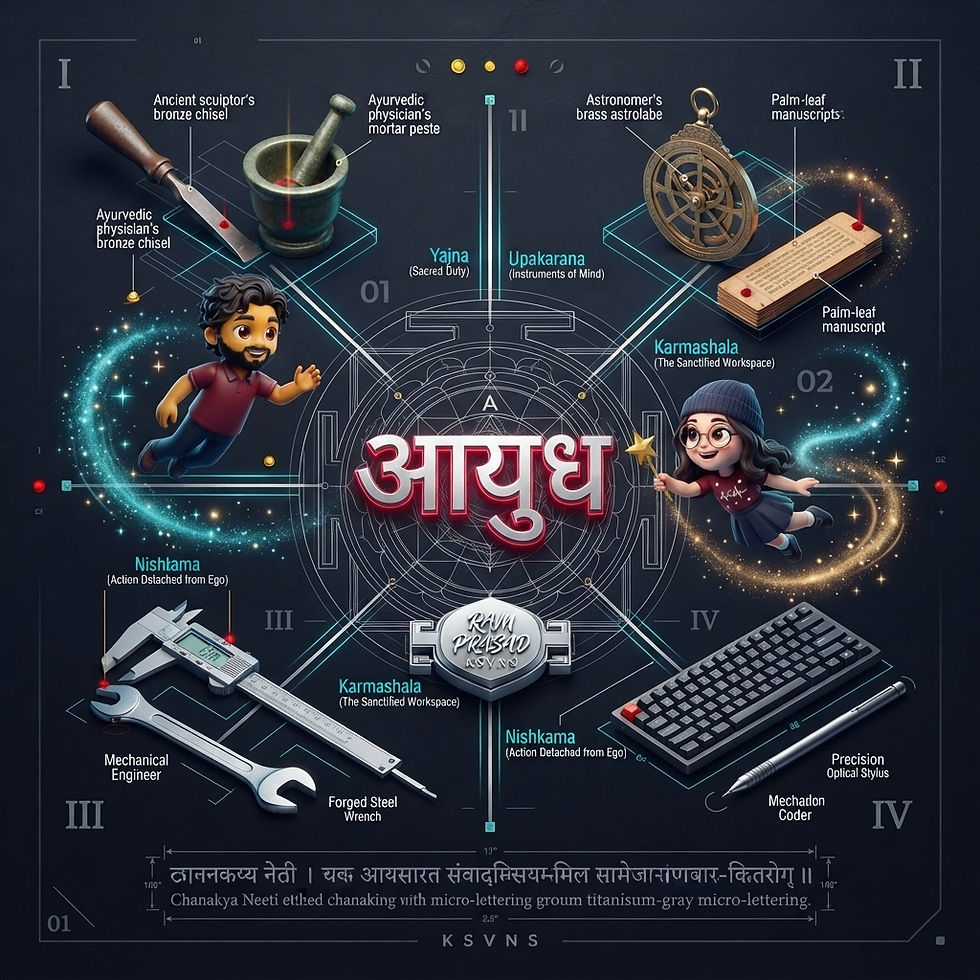
The tradition of Ayudha Puja springs directly from the timeless insight that consciousness resides in every part of creation. The Sanskrit word 'Ayudha' refers to an instrument or tool that empowers a person to perform action. In ancient scriptural thought, work is not treated as a boring chore; it is viewed as 'Yajna' or a sacred duty. When a carpenter holds his chisel, a doctor holds a stethoscope, or a coder sits before a keyboard, the tool becomes an extension of their own mind and hands. Worshipping these tools acknowledges that human skill alone is incomplete without the silent support of these physical instruments.
From the viewpoint of Vedic scientific rhythms and seasonal cycles, Navratri marks a major transition period in nature. During this time, taking a step back to pause, reflect, clean, and re-consecrate our tools cleanses our mind and environment. Ancient temple architecture and geometry also reflect this same principle, where every chisel and measuring cord used by artisans was sanctified before construction began. By applying sandalwood and vermilion to our instruments, we shift our attitude from selfish ownership to humble stewardship.
This practice teaches us Nishkama Karma, which means focusing on doing our duty honestly without anxiety about the end results. When you respect the laptop that runs your business or the scooter that carries you safely to work, you build an emotional bond of mindfulness with your daily environment. This timeless wisdom of Chanakya Neeti reminds us that success stays with those who respect their means of livelihood and keep their instruments ready for action at all times.
📍 2. Step-by-Step Guide to Performing Ayudha Puja at Home and Work

Cleaning and Dusting: Thoroughly clean your tools, vehicles, books, or electronic devices. Wash your car or bike, wipe down desk surfaces, and clean off dust or oil stains to show true reverence to your instruments.
Applying Sacred Marks: Softly apply sandalwood paste (Chandan), turmeric (Haldi), and vermilion (Kumkum) on your vehicles, laptop tops, machinery, or account books.
Floral Decoration: Adorn your workspace, steering wheel, or heavy machinery with fresh marigold flower garlands and mango leaf torans to invite positivity.
Lighting Diya and Incense: Light a traditional brass oil lamp or simple incense sticks nearby, and practice the subtle power of mindful mantras or simple prayers asking for safety and focus.
Offering Prasad and Seeking Blessings: Offer puffed rice (pori), roasted chana, bananas, and jaggery to the divine. Break a coconut or place lemons under vehicle tires for safe travels, and share the prasad with family, coworkers, and helper staff.
📍 3. The Psychological and Workplace Safety Benefits of Tool Reverence

Beyond its rich cultural heritage, Ayudha Puja carries practical psychological and operational benefits that directly improve modern life. Modern occupational health research emphasizes that a clean, well-maintained workspace drastically reduces accidental injury and machinery fatigue. When workers spend an entire day cleaning, oiling, and inspecting their tools during festival time, they spot minor wear and tear before it turns into a dangerous breakdown. This simple festival tradition acts as a brilliant annual preventive maintenance program for every household and industry.
From a psychological perspective, taking time to honor your tools generates deep enduring inner peace and resilience. Modern life often leaves youth feeling burnt out and disconnected from their work. When you stop to thank your tools, you develop a sense of personal pride and professional dignity. Whether you drive a delivery auto-rickshaw or write software code for global clients, your work gains higher purpose when you view your daily equipment with gratitude.
Furthermore, this festive ritual fosters workplace equality and family unity. In factories and offices across India, business owners, senior managers, junior workers, and maintenance staff come together to clean machines and share prasad. This shared activity breaks down social barriers, builds mutual respect, and reinforces the core values of respecting elders and supporting teammates in every community.
📍 4. From Swords to Laptops: Modern Adaptation and Cultural Pride

As Indian society evolved from an agrarian and warrior culture to a modern technological hub, the spirit of Ayudha Puja adapted smoothly without losing its core essence. Centuries ago, kings and soldiers placed their swords, shields, and armor before Goddess Durga on Mahanavami to seek protection and victory. Later, farmers worshipped their plows and bullock carts, while craftsmen worshipped their hammers and looms. Today, modern Indian youth place laptops, smartphones, camera lenses, musical instruments, and medical kits on the puja altar with equal reverence.
This fluid transition showcases the dynamic strength of Sacred Seasonal Festival Traditions. It proves that Indian culture is not an ancient, rigid museum relic, but a living practice that grows alongside human progress. When a young software engineer places a white sticker with turmeric on her MacBook, she is connecting her modern career directly to centuries of ancestral wisdom. This blend of ancient spiritual awareness and modern technology instills deep Cultural Pride in Indian Heritage among the younger generation.
Moreover, this custom reminds us to use technology responsibly and ethically. In an age dominated by screen addiction and digital fatigue, worshipping our digital gadgets transforms how we relate to technology. It reminds us that computers and smartphones are tools created to elevate human potential, earn a honest living, and serve society not distractions that consume our time and peace of mind.
📍 5. Nishkama Karma and Fulfilling Dharmic Duty with Focus

At its heart, Shastra Puja and Ayudha Puja are living expressions of Karma Yoga as taught in the Bhagavad Gita. Lord Krishna emphasizes that human beings have a right to perform their duty, but should never become overly attached or anxious about outcomes. When you worship your tools, you make a conscious promise to perform your daily tasks with sincerity, focus, and excellence. You recognize that the tool is your instrument, but the energy guiding your hands comes from a higher universal source.
Living with moral truth and integrity requires us to care for every asset entrusted to us by nature and society. A bus driver who worships his steering wheel promises to drive safely and protect passenger lives. A student who worships her books promises to read with honesty and apply knowledge for social good. A doctor who honors his instruments resolves to treat patients with empathy and skill. In this way, ritual gratitude turns into civic responsibility and everyday ethical living.
By keeping these traditional values alive in our daily routine, we safeguard our mental composure against modern anxiety and work stress. The ancient wisdom of Chanakya Neeti teaches that a person who respects their tools, stays disciplined, and works with dedication will always achieve lasting prosperity and respect. Let us carry this timeless message forward, celebrating our tools not just on one festival day, but maintaining a spirit of gratitude every single day of our lives.
❓ FREQUENTLY ASKED QUESTIONS
Q1: When is Ayudha Puja celebrated during the festival calendar?
Ayudha Puja is traditionally celebrated on the ninth day (Mahanavami) of the Navratri festival, just before Vijayadashami (Dussehra).
Q2: Can modern digital tools like laptops and smartphones be worshipped during Ayudha Puja?
Yes, absolutely! Ayudha Puja honors any tool or instrument that helps you earn your livelihood or gain knowledge, including computers, software devices, and books.
Q3: What simple ingredients are needed for doing a basic Ayudha Puja at home?
You need basic items like clean water, sandalwood paste (chandan), turmeric (haldi), kumkum, fresh flowers, incense sticks, a coconut, puffed rice (pori), and jaggery.
Q4: Why do people smash lemons under car tires after performing vehicle puja?
Smashing lemons is a traditional symbolic gesture to ward off negative energy, clear away obstacles, and wish for safe, smooth journeys ahead.
Q5: What is the philosophical difference between Ayudha Puja and Shastra Puja?
Ayudha Puja broadly focuses on tools of work, trade, art, and livelihood, while Shastra Puja traditionally refers to honoring weapons and protective implements used for defending righteousness.
© 2026 Ram Prasad K S V N S Recommends. All rights reserved.


Comments