

Bastar Dussehra: Exploring Tribal Rituals and the World's Longest Festival

"In our fast-paced modern lives filled with screen time and constant notifications, ancient Indian wisdom is not just an old story from a history book. It is a living handbook that shows us how to stay calm, live with deep moral truth and integrity, and feel genuine pride in our rich heritage. When we look at Bastar Dussehra in Chhattisgarh, we see a stunning 75-day celebration that brings together dozens of tribal communities to honor Mother Nature and Goddess Danteshwari. Unlike other region festivals that celebrate the defeat of Ravana, Bastar Dussehra focuses on unity, community duty, and deep reverence for the divine feminine."
1. What Is This About? Bastar Dussehra is the world's longest festival, lasting 75 days in Jagdalpur, Chhattisgarh, showcasing unique indigenous rituals and divine reverence without burning Ravana effigies.
2. Why It Matters: It preserves ancient tribal traditions, fosters deep community brotherhood, and teaches us how fulfilling dharmic duty with focus creates lasting societal peace and harmony.
3. Who Is Impacted: It involves over 100 indigenous tribal communities, local forest dwellers, priests, crafts artisans, and millions of visiting devotees across India.
4. Where Applicable: It takes place primarily at the historic Danteshwari Temple and surrounding royal courtyards in Jagdalpur, Bastar region, Chhattisgarh.
5. Action Roadmap: Communities fulfill assigned hereditary roles such as timber collection, chariot building, rope weaving, and sacred deity processions according to ancient Vedic scientific rhythms and seasonal cycles.
"When human work is done as a selfless offering to the divine and the community, action itself becomes worship and brings enduring peace." — Bhagavad Gita
📍 The Unique Origin: A 75-Day Celebration of Devi Danteshwari and Tribal Unity
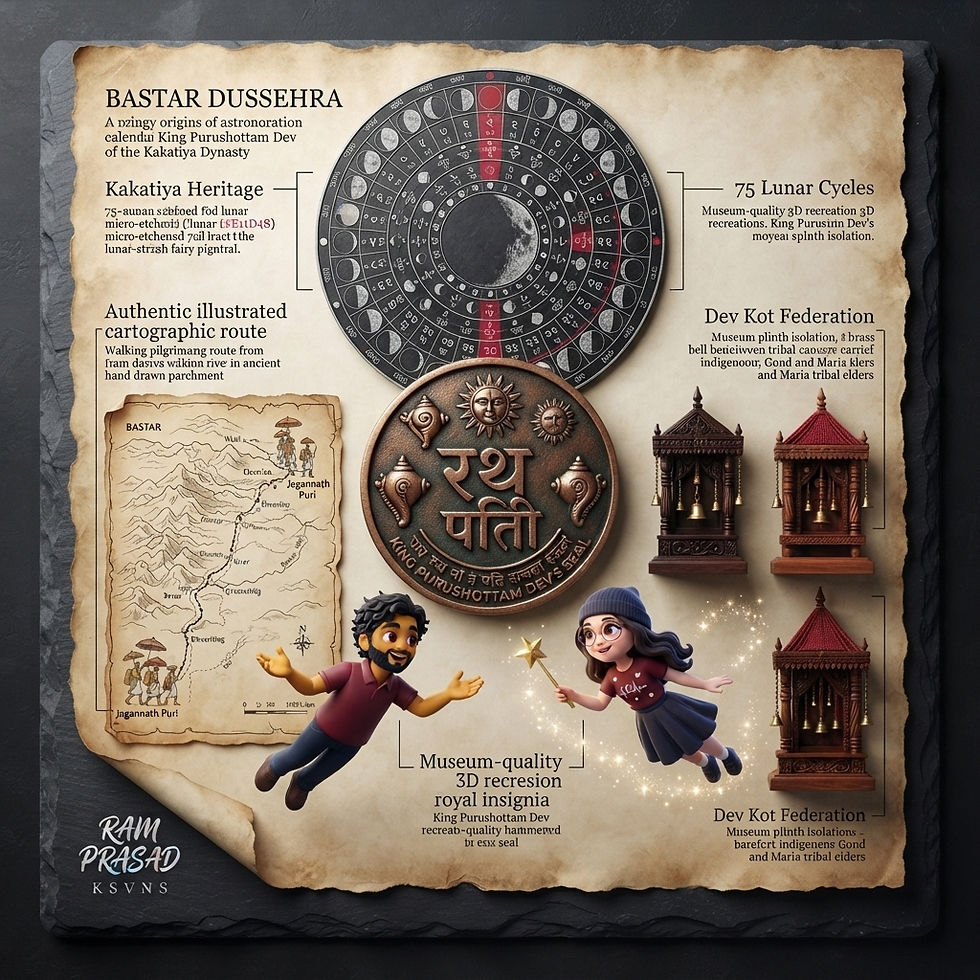
When most people think of Dussehra, they instantly visualize giant effigies of Ravana burning in bright flames to mark the victory of good over evil. However, deep in the heartland of Chhattisgarh, the forest region of Bastar celebrates Dussehra in a completely unique way. Lasting an incredible 75 days from the dark moon night of Shravana to the bright fortnight of Kartik, Bastar Dussehra is recognized worldwide as the longest continuous festival. It does not center on the Ramayana narrative; instead, it is a grand assembly dedicated to Goddess Danteshwari, the presiding divine mother of the region, and the harmonious gathering of local deities brought by dozens of indigenous communities.
The roots of this grand celebration go back to the 13th century during the reign of King Purushottam Dev, the ruler of the Kakatiya dynasty. Historical folklore records that after completing an arduous pilgrimage on foot to the sacred shrine of Jagannath Puri, the king was bestowed with the divine title of Ratha Pati, or Master of the Chariot. Upon returning to his realm in Bastar, he dedicated this honor to Goddess Danteshwari and his subjects. He established a tradition where the royal house and every indigenous tribe would join hands to honor the divine mother, ensuring that no single group felt left out of the kingdom's spiritual and social life.
This grand setup shows us the timeless wisdom of Chanakya Neeti, which emphasizes that true leadership lies in unifying people across all social strata. By giving specific, honorable duties to each tribal group, the historical rulers built an enduring fabric of social trust and moral truth. Today, when you witness thousands of villagers walking barefoot across forest paths carrying their local village shrines called Dev Kots to Jagdalpur, you see living proof of enduring inner peace and cultural pride. It reminds us that our sacred seasonal festival traditions are not mere entertainment; they are life-giving pillars that keep society united and grounded.
📍 The Sacred Rituals: From Pat Jatra to Kachan Gaadi

The 75-day journey of Bastar Dussehra is structured around a sequence of carefully timed rituals that align with Vedic scientific rhythms and astronomy. The grand event begins with Pat Jatra, the sacred worship of the first log of wood brought from the dense sal forests of Machkot. Tribal woodcutters and village headmen bring this timber with immense reverence. Prayers are offered to ask nature for permission and forgiveness before crafting the grand festival chariot. This initial act teaches us environmental respect, showing that human celebration must always seek harmony with nature before using its resources.
Following Pat Jatra, several crucial steps unfold, including Dera Gouri and the deeply mystic ritual of Kachan Gaadi. In Kachan Gaadi, a young girl from the local Mirgan community is respectfully chosen and seated on a swing made of thorny brambles. In a state of divine communion, she grants spiritual permission to the royal family and the community to commence the festival smoothly. This power given to a young daughter of the village highlights the subtle power of mindful mantras and the deep reverence Indian tradition holds for the feminine spirit as the protector of human welfare.
As the festival progresses, other essential ceremonies take place, such as Kalash Sthapana at the temple, Yogi Bithai where a devotee sits in silent, unmoving prayer for nine days for the peace of the land, and Nisha Jatra, an intense night worship ritual. Each ceremony is conducted by designated tribal families who pass down these sacred duties from parent to child. Watching this seamless coordination teaches us the value of Nishkama Karma—fulfilling dharmic duty with focus without worrying about personal glory or monetary gain, leading to unmatched spiritual composure.
📍 The Magnificent Chariot of Bastar Dussehra: Ratha Parikrama and Community Craftsmanship

At the physical and spiritual heart of Bastar Dussehra is the gigantic wooden chariot, known locally as the Ratha. What makes this giant structure an absolute miracle of traditional engineering is ancient temple architecture and geometry. Constructed entirely out of freshly harvested sal wood by hereditary carpenters from the Saonta and Dhakar tribes, the chariot uses zero iron nails, metal bolts, or modern synthetic glues. Every single joint is fitted using wooden pegs and organic interlocking techniques that have been perfected over eight hundred years.
The chariot building process itself is a masterclass in organized teamwork and shared responsibility. Members of the Maria and Muria tribes trek for miles to harvest thick creepers from the jungle, which are twisted together to create massive, unbreakable pulling ropes. Another specific tribe crafts the massive wooden wheels, while others decorate the structure with colorful handloom fabrics and eco-friendly floral garlands. When the giant chariot moves through the roads of Jagdalpur during the Ratha Parikrama, thousands of enthusiastic devotees pull the heavy ropes together, chanting praises to Devi Danteshwari.
When you see people from every background shoulder to shoulder, pulling the immense weight of the chariot, you realize the immense power of collective effort. In our daily lives, whether in a college group project or a office workplace team, we often struggle with ego and miscommunication. The wooden chariot of Bastar shows us that when individual vanity is put aside for a noble common goal, incredible feats become simple. It teaches modern youth that true strength lies in family unity, civic cooperation, and living with moral integrity.
📍 Muria Darbar: Democratic Governance and Ancient Civic Dialogue

One of the most remarkable and forward-thinking aspects of Bastar Dussehra takes place near the end of the festival, known as the Muria Darbar. Long before modern democratic institutions were established, this ancient assembly functioned as a open civic court where village elders, tribal chieftains, priests, and local administration met face to face. Held in the courtyard of the royal palace, the Muria Darbar provided a public platform for anyone to speak openly about local problems, farm concerns, water needs, and community disputes.
During this gathering, the ruler and chief administrators sat not as distant rulers, but as attentive listeners bound by dharmic duty. Every tribal headman, known as a Manjhi or Chalaki, presented the real ground situation of his village. Solutions were discussed democratically, decisions were taken by consensus, and commitments were made in front of Goddess Danteshwari. This system ensured complete transparency, accountability, and mutual respect between the governance leadership and the common people.
For modern citizens, the Muria Darbar offers a practical lesson in civic sense and constructive dialogue. It proves that ancient Indian society was built on strong democratic principles and active community participation. Instead of complaining about social issues on online platforms, we can learn from the Muria Darbar to engage in respectful, face-to-face community dialogue, respect elders, and work together with local authorities to build cleaner, safer, and more harmonious neighborhoods.
📍 Cultural Lessons for Modern Life: Community Harmony and Sustainable Traditions

The conclusion of Bastar Dussehra, marked by the Kutumb Jatra and Ganga Munda Jatra, sees all visiting village deities respectfully bid farewell before returning to their forest shrines. The entire 75-day process leaves behind zero non-biodegradable waste, as every altar, decoration, and ritual component is made from flowers, leaves, wood, and natural clays. This eco-friendly lifestyle is not a modern marketing trend; it is a way of life rooted in Sanskrit etymology and philosophical roots that treat the earth as a living mother.
In our modern urban life, we often feel disconnected from our roots, struggling with stress, comparison, and mental fatigue. Observing how the tribal families of Bastar find immense joy, purpose, and spiritual power in simple, disciplined community rituals can transform our perspective. It shows us that happiness does not come from endless material consumption, but from strong relationships, ethical living, and deep gratitude toward nature and the divine.
By taking inspiration from Bastar Dussehra, you can bring meaningful changes into your daily routine. Respect your family elders, take time to learn about your local heritage, wear comfortable traditional handloom clothing during festivals, and handle your daily work with honest devotion. When you align your personal goals with civic growth and cultural pride in Indian heritage, you develop an unshakeable inner resilience that helps you navigate any challenge in life with grace and strength.
❓ FREQUENTLY ASKED QUESTIONS
Q1: How long does Bastar Dussehra last, and why is it unique?
Bastar Dussehra lasts for 75 days, making it the world's longest festival. It is unique because it does not involve burning effigies of Ravana; instead, it focuses on honoring Goddess Danteshwari and celebrating tribal unity.
Q2: Where is Bastar Dussehra celebrated?
It is celebrated in Jagdalpur, the headquarter town of the Bastar district in the state of Chhattisgarh, centered around the historic Danteshwari Temple.
Q3: Is the festival chariot made using modern tools or metal nails?
No, the massive wooden chariot is constructed entirely out of sal wood using traditional joinery and wooden pegs, without using a single iron nail or modern metal bolt.
Q4: What is the Muria Darbar?
The Muria Darbar is an ancient democratic council held during the festival where tribal leaders, headmen, and government officers sit together to discuss and solve public civic problems.
Q5: Can tourists and visitors participate in Bastar Dussehra rituals?
Yes, visitors are warmly welcomed to witness the public chariot processions, vibrant craft bazaars, and cultural assemblies while respecting local customs and temple etiquette.
© 2026 Ram Prasad K S V N S Recommends. All rights reserved.


Comments